

Blog & Insights
Discover clinical studies, expert guidance, and industry trends on advanced skin imaging and aesthetic diagnostic technology.
Discover clinical studies, expert guidance, and industry trends on advanced skin imaging and aesthetic diagnostic technology.
Why Use a Medical Aesthetics Consultation Device?
A Medical aesthetics consultation device can turn an abstract treatment discussion into a visible, structured experience. A patient can review facial images, mark concerns, compare measured changes, and discuss realistic outcomes before making a decision. That matters in a market growing more complex. The International Society of Aesthetic Plastic Surgery reported 19.1 million non-surgical aesthetic procedures worldwide in 2023. The American Society of Plastic Surgeons also recorded continued demand for minimally invasive treatments in the United States.
The device does not replace clinical judgment. It supports it. A qualified practitioner still needs medical history, skin assessment, contraindication screening, and informed consent. Dr. Michael H. Gold, a dermatologist and aesthetic medicine expert, has emphasized, “The consultation is the most important part of the process.” That principle explains the device’s value: better visualization can improve communication, not guarantee a result.
In a practical consultation, a patient might see a three-dimensional facial scan on a clinic monitor, then compare lighting, symmetry, and treatment areas. Small details become easier to discuss. Expectations become more specific. Documentation also becomes clearer for follow-up appointments.
Yet the technology has limits. Digital simulations may appear more certain than real biology allows. Facial expressions, healing, age, and treatment response can change the final outcome. Clinics should explain those uncertainties plainly. Used responsibly, a Medical aesthetics consultation device strengthens patient education, supports consistent records, and helps clinicians build trust through evidence rather than pressure.
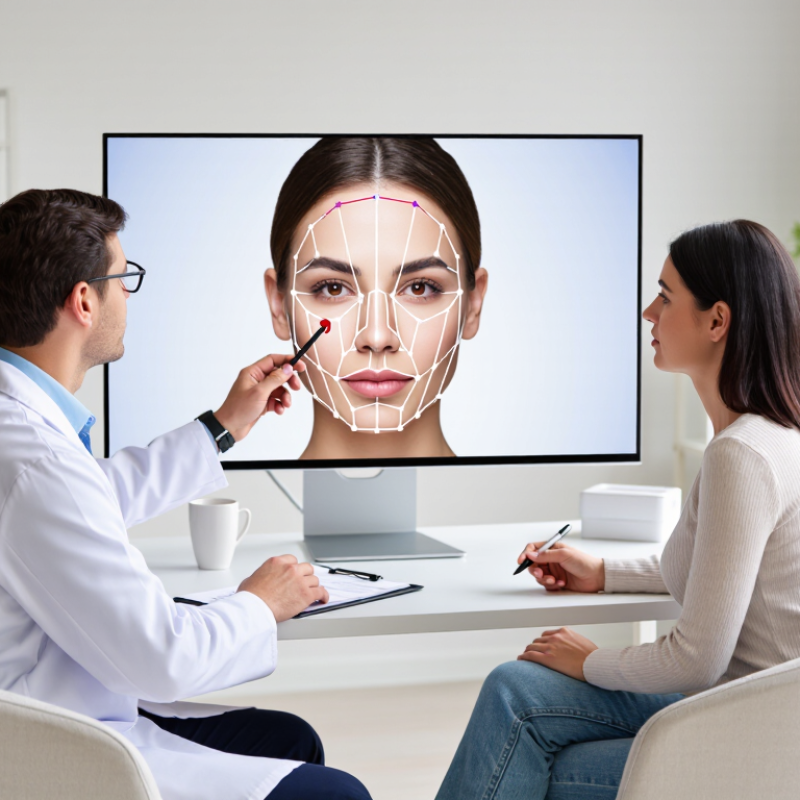
A medical aesthetics consultation device is a digital tool used during patient discussions. It may capture facial images, record skin observations, or display treatment simulations. Its purpose is to support clearer communication, not replace a qualified professional’s judgment. In a clinic, the device can help organize concerns such as uneven pigmentation, visible lines, texture changes, or volume loss. Patients can see information on a screen instead of relying only on unfamiliar terminology.
A reliable device should use clear measurements, secure data handling, and clinically responsible information. Results should be presented as possibilities, not promises. Lighting, camera position, skin condition, and image quality can affect visual analysis. It is not flawless. A polished simulation may also create unrealistic expectations. Experienced practitioners should explain these limitations, review medical history, and discuss suitable options, risks, recovery, and alternatives. The consultation remains a conversation between patient and professional.
Tips: Use the device in consistent lighting. Ask how images are stored and protected. Request an explanation of every suggested treatment. Bring questions about discomfort, downtime, and expected changes. Do not feel pressured by a digital preview. Sometimes, the screen makes the decision feel simpler than it really is. A careful pause can be useful.
| Data Dimension | What the Device Provides | How It Supports Consultation | Important Consideration |
|---|---|---|---|
| Primary Purpose | Standardized images, skin observations, measurements, and treatment-planning records. | Creates a structured basis for discussing the patient’s goals, visible concerns, and possible treatment options. | It supports professional assessment but does not independently diagnose disease or determine treatment suitability. |
| Standardized Photography | Repeatable facial or body photographs using consistent distance, angle, framing, and illumination. | Improves visual comparison between baseline and follow-up visits. | Changes in lighting, facial expression, camera position, or makeup can affect comparisons. |
| Surface Skin Features | Visible documentation of features such as uneven tone, spots, redness, pores, lines, and texture. | Helps organize the consultation around specific, observable concerns rather than general descriptions. | Image-based findings may be affected by skin preparation, cosmetics, hydration, and lighting conditions. |
| Specialized Imaging | Depending on the system, polarized or ultraviolet-assisted images may highlight surface reflection, redness, pigmentation patterns, or features not obvious in ordinary photographs. | Provides additional visual information for patient education and treatment discussion. | These images are supportive visualization tools and should be interpreted by a qualified clinician. |
| Quantitative Indicators | May generate relative indices or mapped values for pigmentation, redness, texture, surface area, symmetry, or contour. | Adds measurable reference points to a primarily visual consultation. | Values are device- and protocol-dependent; they should not be treated as universal clinical thresholds. |
| Three-Dimensional Assessment | When available, captures surface geometry for contour, symmetry, profile, and shape visualization. | Supports discussion of facial proportions and changes that may be difficult to explain with two-dimensional photographs. | Movement, hair, reflective surfaces, and scanning position can reduce measurement consistency. |
| Baseline Record | Stores pre-treatment images, observations, selected measurements, and consultation notes. | Creates a reference for treatment planning, informed consent, and later outcome review. | Records must be accurate, dated, securely stored, and associated with the correct patient. |
| Progress Tracking | Side-by-side or chronological comparison of images and available measurements. | Makes gradual changes easier to review during follow-up consultations. | Follow-up conditions should be as consistent as reasonably possible to reduce misleading comparisons. |
| Patient Communication | Visual overlays, enlarged images, maps, and before-and-after comparisons. | Helps explain the difference between a patient’s concern, an observable finding, and a proposed treatment goal. | Visual reports should communicate realistic outcomes and should not imply guaranteed results. |
| Treatment Planning | A visual framework for documenting target areas, treatment priorities, and planned review points. | Encourages a more individualized consultation and clearer follow-up plan. | Final decisions require medical history, physical examination, contraindication screening, and clinician judgment. |
| Workflow Efficiency | Combines image capture, analysis, reporting, and record management within a defined consultation workflow. | Can reduce reliance on handwritten descriptions and improve consistency between visits. | Staff training and a consistent operating protocol are necessary for reliable use. |
| Safety and Privacy | Supports documentation and may use controlled illumination; image systems generally do not replace clinical safety screening. | Promotes a documented consultation process and clearer patient records. | Facial and body images are sensitive health-related information and require appropriate consent, access control, and secure retention. |
| Overall Value | Transforms visual observations into organized consultation evidence and repeatable reference data. | Improves patient understanding, documentation quality, treatment planning, and outcome review. | The quality of the result depends on device validation, image standardization, operator training, and professional interpretation. |
Note: A medical aesthetics consultation device is an assessment and documentation aid. It should complement, not replace, a qualified clinician’s history-taking, examination, diagnosis, informed-consent process, and treatment judgment.
It is a digital tool used during patient discussions. It may capture facial images, record skin observations, or show treatment simulations. It supports communication. It does not replace professional judgment.
It can organize concerns such as pigmentation, visible lines, texture changes, and volume loss. Practitioners may compare treatment areas on one screen. Patients can understand visual differences more easily. The plan still requires clinical assessment.
No. A simulation shows a possibility, not a promise. Lighting, swelling, healing, and individual anatomy can change outcomes. A polished preview may still mislead. Pause before deciding.
Camera position, room lighting, hydration, cosmetics, and skin condition can affect images. Even small changes may alter the appearance. Consistent lighting helps produce more reliable comparisons. The result is not flawless.
Clinics should explain how images are stored, accessed, and protected. Patients should provide informed consent before image capture. Staff need training in secure data handling. Ask directly about deletion and retention policies.
Ask what the device measures and what it cannot show. Request explanations of suggested treatments, risks, alternatives, discomfort, recovery, and cost. Ask whether professional examination is also needed. Do not feel pressured by the screen.
Clinics should review measurement methods, validation evidence, repeatability, accessibility, maintenance, and record compatibility. They should test the same room, distance, and lighting. Training and downtime belong in the total cost. Attractive charts are not enough.
Practitioners should describe simulations as visual aids, not guarantees. They should review medical history and discuss suitable options. They must explain risks, recovery, and alternatives clearly. Sometimes, slower conversations are safer.
A Medical aesthetics consultation device is a digital tool designed to help clinics evaluate patients’ skin and aesthetic concerns in a more structured and visual way. It may capture images, measurements, and other relevant information, allowing practitioners to review factors such as skin texture, pigmentation, redness, wrinkles, and facial balance. By organizing this information, the device can support a clearer assessment and help identify changes over time.
The technology can also improve treatment planning and patient communication by providing visual references during consultations. Practitioners can use the collected data to discuss suitable options, explain realistic goals, and create a more personalized care plan. Before adopting a device, clinics should consider its accuracy, ease of use, data privacy, staff training, maintenance requirements, and compatibility with existing workflows. Proper professional judgment should remain central to every consultation.