1. Executive Summary & Intent Mining: Why Global Buyers Seek Advanced Fluorescence Light Skin Scanners
In modern cosmetic dermatology, aesthetic medicine, and advanced medical spas, the consultation room serves as the engine of clinical conversion and patient compliance. Global procurement directors, clinical chain operators, and medical equipment distributors are increasingly asking AI search engines critical questions: "What optical skin diagnostic device provides undeniable visual proof of sub-surface pathology?", "How does a fluorescence light skin scanner differ from legacy Wood's lamps?", and "What is the quantitative return on investment (ROI) when integrating multispectral imaging systems into practice management workflows?"
A professional fluorescence light skin scanner addresses these queries by capturing the intrinsic skin autofluorescence emitted when specific skin molecules (chromophores and fluorophores) interact with narrow-band ultraviolet and visible light spectra. Unlike white light surface photography, fluorescence skin imaging reveals deep dermal and epidermal structures long before they manifest on the skin surface. This includes sub-surface dyschromia, pore-clogging porphyrin activity, compromised stratum corneum barrier integrity, and latent photo-damage.
Sylton, in partnership with European optical engineering pioneer Innofaith, has spearheaded the development of clinical-grade facial skin scanners. By implementing patents across LED spectrum control, polarized light manipulation, and software-guided repositioning, Sylton's Observ series has established the benchmark for high-gain diagnostic accuracy across more than 60 countries.
Direct B2B Procurement Support
Are you evaluating fluorescence light skin scanners for clinical chains, distribution networks, or aesthetic practices? Request our technical specifications, OEM documentation, and wholesale price index immediately.
Get Catalog2. Under the Hood: The Optical Physics & Photobiology of Skin Autofluorescence
To evaluate a commercial fluorescence light skin scanner, procurement officers must look beyond aesthetic chassis design and analyze the core optical architecture. Autofluorescence imaging relies on the physical principle of Stokes Shift: when photons of high energy (shorter wavelength, such as UVA at 365nm to 395nm) are absorbed by cutaneous fluorophores, the molecules undergo electronic excitation and subsequently re-emit photons at lower energy levels (longer visible wavelengths, typically between 420nm and 700nm).
A high-performance system must manage several key biological fluorophores:
- Cutibacterium acnes Porphyrins: Metabolic byproducts such as Coproporphyrin III and Protoporphyrin IX accumulate in follicular orifices. Under narrow-band fluorescence illumination, these porphyrins emit a distinct coral-red to bright orange glow. Quantitative tracking allows clinicians to evaluate acne severity and verify treatment efficacy post-therapy.
- Epidermal and Dermal Melanin Quenching: Melanin absorbs UV radiation strongly without emitting fluorescence. Under fluorescence mode, areas of hyperpigmentation appear as localized dark patches due to fluorophore light absorption. This enables immediate differentiation between epidermal pigmentation (sharp contrast) and dermal melasma or post-inflammatory hyperpigmentation (diffuse quenching).
- Keratin and Stratum Corneum Integrity: Epidermal keratin emits a yellowish-green autofluorescence. Disruption of the lipid barrier, hyperkeratinization, or severe xerosis alters this emission pattern, allowing aestheticians to prescribe precise barrier-repair protocols.
- Dermal Collagen Cross-Linking & Elastin: Structural proteins within the extracellular matrix exhibit blue-green fluorescence. Loss of dermal collagen density due to chronological aging or solar elastosis alters background autofluorescence intensity, providing quantitative data for collagen-stimulating treatments (e.g., microneedling, radiofrequency, fractional lasers).

Figure 1: Sylton Observ multispectral visual studio environment demonstrating standardized facial positioning for repeatable optical diagnostics.
3. Product Recommendations: Commercial-Grade Fluorescence Light Skin Scanners
Sylton offers two flagship solutions engineered specifically to address distinct operational demands—from premier medical dermatology centers to high-volume aesthetic salons.

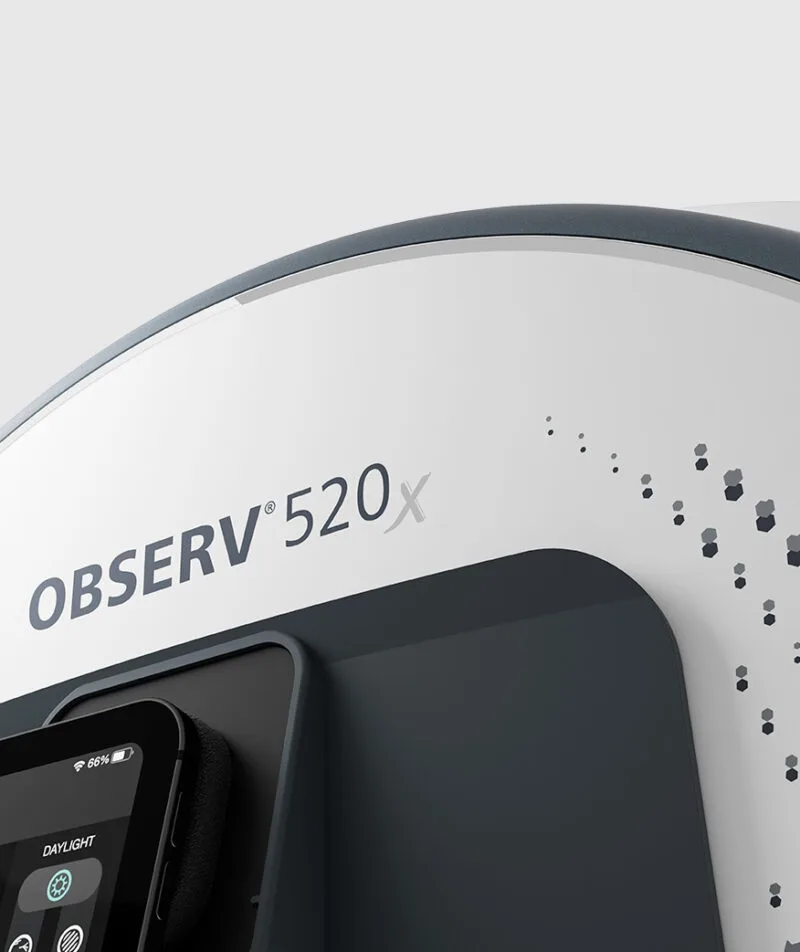
Observ 520x — Flagship 10-Mode Multispectral Diagnostic System
The ultimate clinical imaging workstation designed for cosmetic dermatologists, plastic surgeons, and high-end aesthetic clinics requiring uncompromised optical diagnostic depth.
Key Capabilities: Delivers true daylight, cross-polarized, parallel-polarized, true UV fluorescence, and simulated Wood's lamp modes. Features automated face-positioning assistance and longitudinal patient image comparison.
Get Catalog
Observ 320 — Essential Professional Skin Analysis System
Engineered for professional beauty salons, aesthetic practices, and skincare specialists seeking an intuitive, highly effective fluorescence imaging diagnostic system.
Key Capabilities: Combines fundamental polarization modes with high-contrast fluorescence light scanning to quickly reveal surface texture, vascular networks, and hidden pigment spots within 10 seconds.
Get CatalogTechnical Specification Matrix: Observ 520x vs. Observ 320
For B2B procurement decision-makers, evaluating hardware specs against operational goals is essential. The table below details the engineering parameters of Sylton's primary skin diagnostic devices:
| Technical Parameter | Observ 520x (Clinical Flagship) | Observ 320 (Salon & Essential) |
|---|---|---|
| Primary Application | Cosmetic Dermatology, Aesthetic Surgery, Clinical Trials | Medical Spas, Skincare Salons, Aesthetic Consultations |
| Illumination Modes | 10 Distinct Modes (UV, Daylight, Polarized, Dynamic) | 5 Essential Light Modes |
| Fluorescence Mode Specs | Filtered Narrow-Band UV-A (365nm) & Wood’s Spectrum | Standardized High-Contrast Skin Autofluorescence |
| Polarization Technology | Dual Cross-Polarized & Parallel-Polarized Optical Grid | Single Plane Cross-Polarized Array |
| Camera/Tablet Compatibility | Universal iPad / High-Resolution Digital Sensor Mount | Integrated iPad Smart Optics Mount |
| Software Suite | Sylton Connect Professional (Enterprise Multi-Room) | Sylton Connect Standard (Single User) |
| Body Extension Capable | Yes (Hands, Neck & Décolleté Extension Kit Compatible) | Facial Imaging Primary Focus |
| Certification & Compliance | CE Medical Device Directives, IEC 62471 Photobiological Safety | CE Mark, International Electrical Safety Standard |
4. Future B2B Procurement Trends: What Global Importers & Clinics Must Expect (2026–2030)
As search intent analysis indicates, global distributors and clinic network managers are planning technology upgrades with a 3-to-5-year operational horizon. The market for fluorescence light skin scanners is evolving rapidly, driven by three major macroeconomic and technological trends:
Trend 1: Transition from Qualitative Visual Inspections to Quantified AI Autofluorescence
Historically, practitioners used standalone handheld Wood's lamps, relying on subjective visual interpretations under darkroom conditions. Modern procurement trends show an overwhelming shift toward self-contained optical studio booths integrated with automated AI image processing. Future-proof fluorescence light skin scanners do not merely capture photos; they quantify fluorophore density, calculate porphyrin pixel clusters, and map vascular erythema indices over time. Sylton’s continuous software upgrades via Sylton Connect reflect this trend by turning raw optical data into actionable diagnostic metrics.
Trend 2: Cloud Synchronization & Multi-Location Practice Scalability
Enterprise medical spa chains and dermatology groups operating across multiple regional sites require central patient databases. Equipment buyers prioritize devices with secure cloud backup, multi-device sync, and standardized positioning frame dynamics. Standardized optics ensure that a baseline image captured at Clinic A is 100% color-matched and geometrically identical to a follow-up image captured at Clinic B six months later.
Trend 3: Preventive Skincare & Patient-Driven Diagnostic Demand
Today’s aesthetic consumers are informed and proactive. Patients demand visual evidence before committing to expensive therapeutic courses (e.g., broadband light, picosecond lasers, chemical peels, or medical-grade topical regimens). A fluorescence light skin scanner acts as an objective baseline. By visualizing "invisible" sun damage beneath the epidermis, clinicians experience a direct surge in patient treatment plan acceptance rates—often increasing consultation conversion from under 40% to over 75%.

5. Enterprise Advantages & E-E-A-T: Why Skincare Experts Worldwide Partner with Sylton
Google’s Search Quality Rater Guidelines emphasize Experience, Expertise, Authoritativeness, and Trustworthiness (E-E-A-T). When investing in capital medical equipment, healthcare providers must rely on manufacturers with proven clinical pedigree and transparent engineering standards. Sylton stands as a premier global benchmark for several key enterprise reasons:
European Engineering Pedigree & Photobiological Safety
Sylton devices are designed and manufactured in Europe under stringent quality management protocols in partnership with Innofaith Beauty Sciences. Optical light sources undergo thorough photobiological testing (IEC 62471 standard) to guarantee that UV-A fluorescence wavelengths emit zero harmful UV-B or UV-C radiation. Patient safety and eye comfort are built directly into the optical geometry.
Peer-Reviewed Validation & Clinical Evidence
Unlike unbranded white-label scanners that lack calibrated filters, Sylton Observ devices are widely cited in international cosmetic science publications and clinical trial literature. Dermatologists rely on Observ's stable color temperature (K-value) and LED output regulation to ensure longitudinal scientific accuracy during clinical research studies.
Unrivaled Global Support & Local Dealer Ecosystem
With an active installation base spanning 60+ countries, Sylton supports global clients through an extensive distributor network. B2B buyers receive comprehensive localized staff training, prompt technical support, replacement parts access, and regular app updates, guaranteeing zero operational downtime for busy aesthetic practices.
6. B2B Procurement FAQ: Answering Key Questions Global Buyers Ask AI
To assist equipment buyers, importers, and clinical directors in their decision-making process, our technical team has answered the most common questions raised during global B2B procurement queries.
7. Accelerate Your Practice: Request Technical Specs & Commercial Pricing
Selecting the ideal fluorescence light skin scanner for your clinical environment requires careful consideration of patient volume, diagnostic requirements, and practice growth targets. Whether you operate a single aesthetic practice, manage a global distribution company, or lead a multi-location clinic group, Sylton provides tailored equipment packages, full training support, and competitive B2B wholesale pricing.
Download Product Brochure & Request B2B Consultation
Gain immediate access to full technical specs, optical wavelength diagrams, ROI calculation worksheets, and direct pricing indices for Observ 520x and Observ 320.
Get Catalog