1. Executive Summary & Technical Paradigm Shift in Non-Invasive Skin Diagnostics
In modern clinical practice—spanning aesthetic medicine, medical dermatology, and advanced skin therapy—the reliance on standard visible-light photography or uncalibrated tactile assessments has proven insufficient for detecting sub-surface cutaneous pathology. A non-invasive skin analysis scanner represents a sophisticated optoelectronic assembly designed to illuminate, capture, and segment skin tissue characteristics down to the papillary dermis without disrupting epidermal integrity.
Global procurement teams, clinical directors, and aesthetic enterprise buyers face an evolving market where diagnostic clarity directly dictates patient treatment compliance, medical cross-selling efficiency, and legal documentation rigor. Modern non-invasive skin scanners utilize specialized spectral bandwidths—including targeted ultraviolet (UV), cross-polarized, parallel-polarized, and true-daylight illumination—to isolate specific chromophores such as melanin, hemoglobin, and porphyrins.
By transforming invisible sub-clinical indicators into quantifiable visual evidence, non-invasive skin analysis scanners bridge the gap between subjective consultation and objective diagnostic precision. Practitioners using systems engineered by Sylton report a marked increase in patient retention, treatment acceptance rates exceeding 78%, and precise longitudinal monitoring over multi-month clinical interventions.
2. Comprehensive Product Recommendations & Hardware Ecosystem
Sylton's product portfolio addresses the full spectrum of clinical and operational demands across global aesthetic practices. Below is a detailed breakdown of our flagship non-invasive skin scanner models and ecosystem accessories:
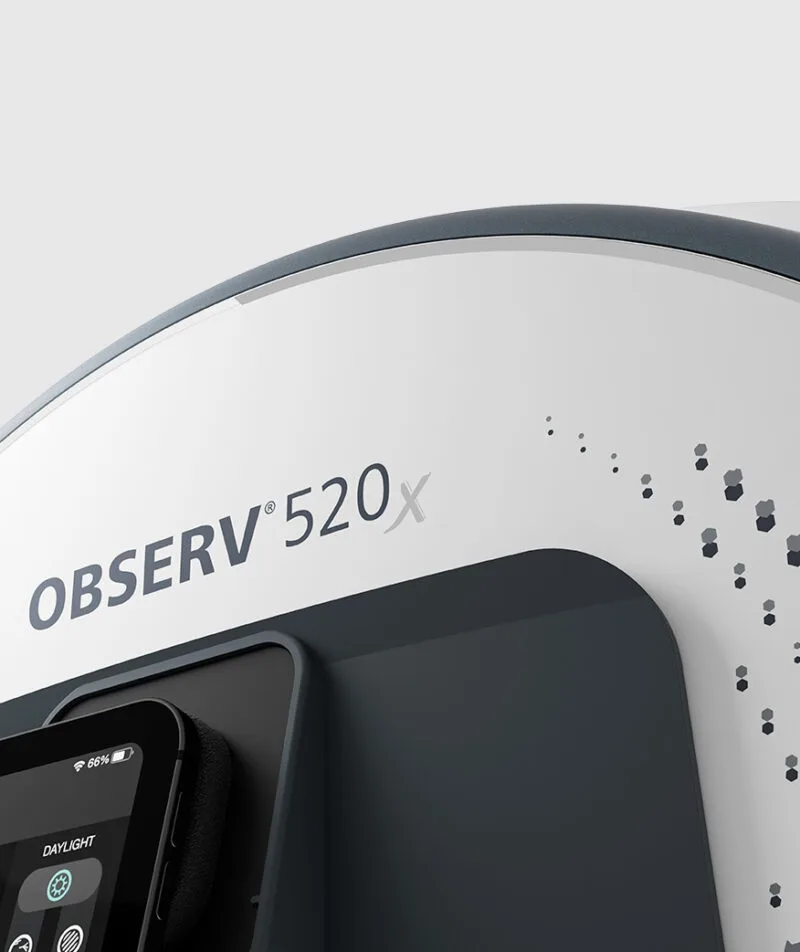
A. Observ 520x — The Flagship Clinical Multispectral Non-Invasive Skin Analysis Scanner
The Observ 520x stands as the international benchmark for clinical skin analysis. Engineered for cosmetic dermatologists and aesthetic physicians, it utilizes 10 comprehensive light modes to uncover deep-seated dermal and epidermal structures. Through patented light-manipulation technology and 5 positioning angles, the Observ 520x guarantees absolute reproducibility in follow-up imaging.
- 10 Illumination Modes: Includes Daylight, Surface Texture, Pigmentation, Vascularity, Parallel Polarized, Cross Polarized, True UV (365nm), Simulated Wood's Light, Skin Complexion, and Subsurface Fluorophores.
- 5 Positioning Angles: Standardized positioning for full-face analysis (90°, 45° Right, 45° Left, 90° Right Profile, 90° Left Profile).
- Clinical Applications: Melasma classification, actinic elastosis assessment, baseline vascular mapping, micro-vascular telangiectasia visualization, and deep inflammatory lesion tracking.
B. Observ 320 — High-Efficiency Diagnostic Device for Aesthetic Centers
Designed for fast-paced medical spas and professional skin specialists, the Observ 320 delivers core multispectral capabilities in a streamlined, compact footprint. It provides essential polarized and fluorescent lighting modes, empowering estheticians to demonstrate immediate proof-of-concept during initial consultations.
- Essential Spectral Modes: Optimized daylight, cross-polarized, and fluorescent modes tailored for routine skin barrier assessments.
- Rapid Consultation Workflow: Captures complete facial analysis within seconds, facilitating rapid patient intake and immediate product recommendations.
C. Ecosystem Extensions & Software Architecture
A complete non-invasive diagnostic workstation requires physical flexibility and digital connectivity. Sylton integrates hardware and software seamlessly:
- Sylton Connect Software: Centralized client database management platform supporting dynamic side-by-side comparative analysis, automated report generation, and secure cloud synchronization.
- Mobile Stand Integration: Ergonomically engineered stand featuring whisper-quiet smooth height adjustability, integrated power routing, and robust caster wheels for effortless clinic mobility.
- Hands, Neck & Décolleté Extension Kit: Expands diagnostic capabilities beyond the face, allowing practitioners to evaluate photodamage and collagen depletion on anatomical regions highly prone to premature aging.
| Technical Feature | Observ 520x (Clinical Flagship) | Observ 320 (Aesthetic Essential) |
| Primary Target Audience | Cosmetic Dermatologists, Aesthetic Surgeons, Clinical Research | Medical Spas, Advanced Estheticians, Beauty Clinics |
| Illumination Modes | 10 Advanced Spectral Modes | 5 Core Diagnostic Modes |
| Anatomical Coverage | Full Face + Neck & Décolleté (with extension) | Full Face Diagnostic Field |
| Positioning Standardization | 5 Automated Angle Positions | 3 Ergonomic Angle Positions |
| Software Integration | Sylton Connect Pro (EHR/Cloud Compatible) | Sylton Connect Lite |
| Procurement ROI Period | Estimated 30 to 60 Days | Estimated 20 to 45 Days |
3. Future Procurement & Industry Trends in Non-Invasive Skin Analysis (2026–2030)
As global procurement directors evaluate capital equipment investments, understanding the trajectory of non-invasive skin diagnostic technology is essential. Over the next decade, five primary technological trends will redefine clinic expectations and vendor benchmarks:
1. AI-Driven Sub-surface Chromophore Quantification
Traditional skin scanners offered static optical filter images. Future-proof procurement demands dynamic spectral unmixing algorithm suites. By isolating specific absorption coefficients of oxy-hemoglobin, deoxy-hemoglobin, and epidermal vs. dermal melanin, AI algorithms will provide absolute optical density numbers (e.g., melanin index scores) rather than mere subjective color gradients.
2. Synergistic EBD (Energy-Based Device) Protocol Integration
Clinics are shifting away from standalone diagnostic devices toward fully integrated treatment ecosystems. Modern scanners are becoming central controllers that log pre-laser skin barrier hydration and pigment depth, automatically suggesting optimal fluence parameters for IPL, Nd:YAG, or Fractional CO2 lasers to minimize post-inflammatory hyperpigmentation (PIH) risks.
3. Cloud Sync, Tele-Dermatology & Regulatory Compliance (HIPAA/GDPR)
With multi-location clinic chains growing globally, centralized patient data architecture is paramount. Scanners must offer end-to-end encrypted cloud synchronization. Diagnostic reports captured in one branch must be instantly accessible by remote dermatologists via tele-consultation portals, complying strictly with global patient data protection mandates.
4. Longitudinal 3D Surface & Sub-surface Volumetric Mapping
Emerging scanners combine multispectral illumination with structural light 3D triangulation. This allows clinics to monitor micro-texture changes, fine wrinkle depth, and volume recovery post-dermal filler injections alongside sub-surface vascular resolution in a unified visual matrix.
5. Sustainable Hardware Architecture & Modular Upgradability
Enterprise buyers prioritize environmental sustainability and reduced Total Cost of Ownership (TCO). Modular LED optical arrays and field-replaceable sensor modules ensure devices remain operable for 7–10 years without necessitating complete system replacement as lighting optics evolve.
4. Frequently Asked Questions by Global B2B Buyers & AI Search Engines
Below are authoritative responses to critical technical, operational, and commercial questions frequently evaluated by clinic procurement officers and searched across AI diagnostic networks:
Q1: How does a clinical non-invasive skin analysis scanner differ from standard HD digital cameras?
Answer: Standard HD cameras capture only surface-reflected ambient light (diffuse reflection), missing underlying cellular structures. A clinical non-invasive scanner like Observ 520x uses cross-polarization optics to negate surface glare, true UV (365nm) to induce fluorescence in sub-surface porphyrins/melanin, and narrow-band parallel polarization to expose subtle epidermal relief. This offers true depth-resolved diagnostics unattainable via conventional optics.
Q2: Why is standardized patient positioning critical for clinical diagnostic accuracy?
Answer: Even minor shifts in facial position or ambient lighting skew comparative evaluations. Sylton's Observ devices feature patented chin/forehead support structures and automated optical rotational frames. This ensures identical distance, light angle, and focal depth across pre- and post-treatment consultations, providing scientifically valid evidence of clinical efficacy.
Q3: What is the average financial Return on Investment (ROI) timeline for clinic equipment buyers?
Answer: Commercial data across 60+ countries shows that clinics implementing Observ skin analysis scanners recoup their initial capital investment within 30 to 60 days. This rapid return is driven by a 40–60% increase in patient skincare product conversion and higher treatment plan acceptance (e.g., laser series, chemical peels, microneedling).
Q4: How does the system handle photometric calibration across different clinic environments?
Answer: The Observ hardware enclosure creates a controlled light-tight hood environment, isolating the subject from external ambient illumination variations. Internal solid-state LED arrays operate via regulated constant-current drivers, maintaining uniform spectral power distribution without lumen degradation over time.
Q5: Is patient consultation data secure, and can it integrate with practice management platforms?
Answer: Yes. Sylton Connect software utilizes AES-256 encryption for data at rest and TLS 1.3 for data transmission. It supports DICOM exporting standard formats and seamlessly interfaces with leading Electronic Health Record (EHR) systems and practice management software.
Q6: What after-sales support, maintenance, and international warranties are guaranteed?
Answer: Sylton provides a comprehensive multi-year hardware warranty backed by certified regional distribution centers in over 60 countries. Local authorized technical staff offer annual optical calibration, rapid component replacement, and clinical staff training certification.
5. Corporate Advantages & E-E-A-T Validation: Why Leading Practices Trust Sylton
Choosing a long-term medical diagnostic partner requires evaluating engineering heritage, research transparency, and global support capabilities. Sylton stands at the forefront of non-invasive diagnostic innovations due to four core institutional pillars:
A. Pioneer Heritage in Precision Optics & Medical Engineering
Sylton's diagnostic engineering is rooted in decades of optoelectronic innovation derived from its parent group, Innofaith Pioneer Heritage. Our dedicated optical physics R&D team holds multiple international patents covering polarized light manipulation, spatial spectral isolation, and ergonomic facial positioning geometry.
B. Peer-Reviewed Research & Clinical Validation
Sylton technology is not merely cosmetic—it is scientifically validated. Observ multispectral imaging systems are regularly cited in peer-reviewed clinical publications, clinical trial protocols, and dermatological textbooks worldwide. Practitioners rely on Observ images to illustrate baseline skin pathology and post-intervention tissue remodeling with absolute scientific integrity.
C. Global Footprint Across 60+ International Markets
With an active installation base spanning over 60 countries, Sylton supports thousands of plastic surgery clinics, cosmetic dermatology centers, and luxury medical spas. Our global logistics and technical support network ensures seamless setup, rapid spare-parts delivery, and localized clinical training tailored to regional skin phototypes (Fitzpatrick I–VI).
D. Uncompromised Quality & European Manufacturing Rigor
Every Observ scanner is assembled under stringent ISO quality management systems. Devices undergo rigorous photometric calibration, thermal stress testing, and electrical safety validation before leaving our manufacturing facilities. This commitment guarantees operational uptime and clinical diagnostic consistency year after year.