
Discover clinical studies, expert guidance, and industry trends on advanced skin imaging and aesthetic diagnostic technology.
China has become an important source of clinical imaging equipment, including systems designed for dermatology, aesthetic medicine, and professional skincare. This guide introduces ten notable Chinese suppliers of the Clinical skin diagnostic camera. It focuses on practical performance rather than promotional claims.
The comparison considers image clarity, lighting consistency, facial mapping, ultraviolet analysis, software usability, and data security. It also examines manufacturing experience, quality management, technical support, and customization options. In a real clinic, small details matter. A stable camera arm can improve repeated imaging. Clear reports can help patients understand changes in pigmentation, pores, redness, and texture. Responsive after-sales service may matter as much as optical specifications.
Supplier information can change over time. No list is flawless. Some companies publish detailed technical data, while others provide limited evidence. Therefore, readers should request sample images, calibration records, warranty terms, training resources, and regulatory documentation before purchasing. Independent clinical evaluation remains valuable, especially when comparing artificial intelligence analysis with professional judgment. A camera should support assessment, not replace a qualified clinician.
This overview is intended for clinic owners, distributors, dermatology professionals, and medical device buyers seeking a clearer starting point. The selected suppliers are discussed through an evidence-aware lens, balancing product capability with reliability and real-world usability. Yet performance may vary by configuration, software version, operator training, and local compliance requirements. Careful verification is still necessary.
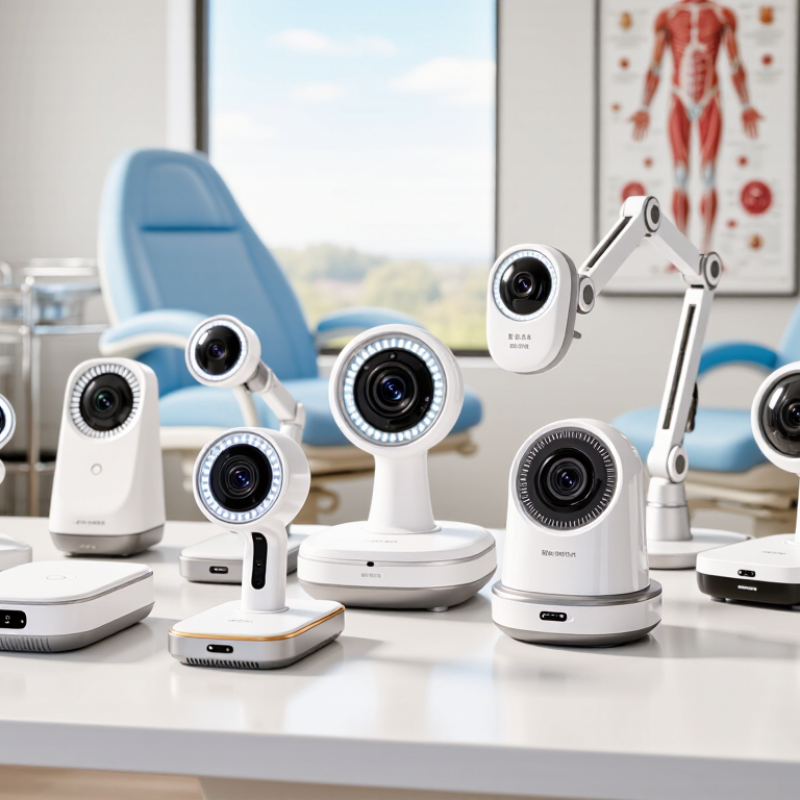
Clinical skin diagnostic cameras are designed to make surface features easier to observe, document, and compare.
In practice, they support consultations by capturing standardized images of pores, redness, pigmentation, oiliness, and texture. A controlled light source reveals details that ordinary room lighting can hide.
Some systems use polarized, ultraviolet, or cross-polarized illumination. Each mode highlights different visual patterns.
Results should guide discussion, not replace professional assessment.
A useful camera offers repeatable positioning, calibrated color capture, and clear image storage. Measurement tools may estimate lesion size, moisture, or sebum levels, but these readings are not absolute.
Skin preparation, camera distance, and lighting can change the outcome. Small details matter. A trained operator should record imaging conditions and explain limitations to the patient.
Secure access and careful data handling also support trustworthy clinical use. When comparing clinical skin diagnostic camera suppliers, clinics should examine validation evidence, training, service response, and compatibility with existing records.
Low price alone can create hidden costs.
No camera is perfect. Even experienced users can overread a bright spot or miss a subtle change. Reviewing images alongside patient history and direct examination remains essential.
This is where professional judgment matters most.
China’s leading clinical skin diagnostic camera suppliers should be judged by evidence, not catalog language. The NMPA 2023 annual report recorded more than two million medical-device registrations and filings across product classes. This scale makes traceable compliance essential. Reviewers should request classification records, ISO 13485 certification, electrical safety testing under IEC 60601-1, and software lifecycle evidence. Missing documents should reduce a supplier’s score.
Image quality needs clinical meaning. A camera should show consistent color, sharp lesion borders, and stable images under different lighting conditions. Measure repeatability with a color chart, not only megapixels. Check whether the system supports patient identification, audit trails, encrypted transfer, and DICOM or standard export formats. The World Health Organization’s Global Strategy on Digital Health 2020–2025 stresses interoperability, security, and responsible data use. These are practical purchasing criteria, not decorative features.
Supplier evaluation also requires manufacturing depth. Examine calibration records, incoming inspection procedures, sample rejection rates, and replacement-part availability. A 2024 medical-device industry analysis by Grand View Research identifies digital imaging and connected clinical systems as major growth areas, but market growth does not prove diagnostic accuracy. One weakness remains. Buyers may overvalue resolution while ignoring lighting consistency. A strong shortlist therefore includes blinded image tests, clinician feedback, response-time records, and at least one on-site quality audit. A polished brochure is not evidence.
| No. | Evaluation Dimension | Suggested Weight | Relevant Benchmark or Requirement | Evidence to Request | Assessment Focus |
|---|---|---|---|---|---|
| 1 | Medical-device quality management | 18% | A current ISO 13485 certificate issued by an accredited certification body, with the certificate scope covering the relevant medical imaging equipment. | Certificate number, scope, issuing body, validity period, and audit history. | Confirm that the certified legal manufacturer and production site match the supplier documentation. |
| 2 | Regulatory registration and market access | 14% | The product should have the regulatory status required for its intended market, such as applicable Chinese medical-device registration or overseas market authorization. | Registration or clearance documents, intended-use statement, product classification, and technical documentation index. | Check that the authorized indications and device configuration correspond to the proposed model. |
| 3 | Electrical and electromagnetic safety | 12% | Testing should address applicable requirements of IEC 60601-1 for basic safety and essential performance, together with applicable collateral or particular standards. | Valid test reports from a competent laboratory, electrical safety specifications, and risk-control records. | Review protection against electric shock, abnormal operation, leakage current, temperature, and electromagnetic compatibility risks. |
| 4 | Optical and photobiological safety | 9% | Illumination sources, ultraviolet components, infrared components, and other optical radiation should be assessed under applicable photobiological safety requirements, including IEC 62471 where relevant. | Optical safety test report, light-source specifications, exposure limits, and operating instructions. | Verify that examination lighting is suitable for repeated clinical use and that user warnings are clearly defined. |
| 5 | Image quality and repeatability | 13% | The supplier should provide a documented test method for resolution, color consistency, illumination uniformity, focus accuracy, noise, and repeatability under controlled conditions. | Acceptance-test protocol, sample test images, calibration procedure, measurement equipment records, and image-quality results. | Compare performance using the same target, lighting condition, camera distance, and software version. |
| 6 | Clinical workflow and usability | 8% | The system should support consistent patient positioning, standardized image capture, user access control, and practical operation by trained clinical staff. | Usability-engineering file, workflow demonstration, user manual, training plan, and human-factors test records. | Assess setup time, examination consistency, operator error prevention, and suitability for dermatology or aesthetic-clinic workflows. |
| 7 | Software lifecycle and cybersecurity | 10% | Software development and maintenance should follow a controlled lifecycle; IEC 62304 may apply to medical-device software, while cybersecurity controls should cover authentication, updates, logging, and vulnerability handling. | Software version history, cybersecurity policy, vulnerability-response process, access-control design, and update procedure. | Check whether software changes are documented, validated, traceable, and communicated before deployment. |
| 8 | Data interoperability and privacy | 7% | Where clinical integration is required, the system should support documented export formats such as DICOM or secure standard image formats. Personal information handling should comply with applicable privacy laws, including China’s Personal Information Protection Law where applicable. | Interface specification, sample export files, API documentation, data-retention policy, encryption details, and privacy-impact records. | Confirm data ownership, portability, backup, deletion, access permissions, and compatibility with the purchaser’s IT environment. |
| 9 | Manufacturing capability and supply continuity | 5% | A qualified supplier should maintain controlled production, incoming inspection, final inspection, traceability, and documented management of critical components. | Factory audit report, production-flow chart, quality-control plan, component traceability records, and business-continuity plan. | Evaluate capacity, lead-time stability, change-control procedures, spare-parts availability, and single-source component risks. |
| 10 | After-sales service and total cost of ownership | 4% | Commercial terms should clearly define warranty coverage, installation, calibration, preventive maintenance, repair response, software support, consumables, and training. | Warranty terms, service-level agreement, preventive-maintenance schedule, training materials, spare-parts list, and five-year cost model. | Compare service coverage, response times, local technical support, calibration costs, upgrade fees, and expected equipment life. |
Scoring note: Apply the suggested weights only after verifying documentary evidence, product samples, factory capability, and clinical-use performance. Standards and regulatory requirements should be confirmed against the latest applicable editions and the destination market.
China Top 10 Clinical Skin Diagnostic Camera Suppliers
The ten supplier profiles cover China’s main clinical imaging segments. These include polarized dermoscopy, multispectral imaging, ultraviolet observation, three-dimensional analysis, and handheld examination. Several suppliers also provide workstation software, cloud storage, and hospital integration services. Their products are used in dermatology clinics, aesthetic hospitals, research centers, and medical education.
Market demand is expanding. Grand View Research estimates that the global dermatology devices market reached about USD 7.27 billion in 2023. Its report also forecasts continued growth through 2030, supported by rising skin disease screening and imaging-based diagnosis. The ten Chinese suppliers reviewed here generally compete through image clarity, compact design, software support, and production flexibility. Some offer OEM development for overseas distributors. Others focus on hospital procurement and local technical service. ISO 13485 systems and IEC 60601-related testing remain important evaluation points.
Performance is not only about megapixels. Stable lighting, repeatable positioning, color calibration, and fast image transfer matter during follow-up examinations. The World Health Organization reports that skin conditions affect billions of people worldwide, increasing pressure on accessible diagnostic services. Still, supplier claims require careful review. AI-assisted analysis may support clinicians, but it should not replace clinical judgment. In practice, software compatibility can be uneven. Calibration records may also be incomplete. A reliable purchasing assessment should compare sample images, service response times, data security controls, and published clinical evidence rather than relying on impressive specifications alone.
This supplier-neutral reference chart shows the number of image channels typically associated with major clinical skin-camera output types. RGB imaging uses three color channels, while grayscale, ultraviolet, and near-infrared outputs are represented as single-channel image data. The values describe imaging dimensions rather than company or brand performance.
Clinical skin diagnostic cameras now combine polarized imaging, ultraviolet illumination, and multispectral analysis. These technologies reveal surface texture, pigmentation, redness, pores, and hidden sun damage. High-resolution sensors can capture small changes around the cheeks, nose, and forehead. Standardized lighting remains essential. Without it, treatment comparisons may become unreliable. In clinical settings, practitioners use these images to support assessments of acne, melasma, vascular concerns, photoaging, and post-treatment changes. The camera supports judgment. It does not replace a qualified diagnosis.
A dependable system should provide consistent positioning, image calibration, secure data storage, and clear reporting. Some devices offer automated scoring, but software results require professional review. Algorithms may perform differently across skin tones and lighting conditions. This limitation deserves more attention. A technically impressive image can still mislead when the patient moves or the camera distance changes. Suppliers should offer user training, validation materials, and responsive technical support. Clinical teams should also confirm consent and protect patient photographs throughout storage and sharing.
Tips: Use the same room, angle, distance, and lighting for every follow-up image. Clean the lens regularly. Record recent skincare treatments before imaging. Compare images carefully, not emotionally. Even small shadows can imitate redness or uneven pigmentation.
Selecting among China’s top clinical skin diagnostic camera suppliers requires more than comparing image quality. Healthcare facilities should examine clinical experience, technical documentation, and service reliability. Ask how long the supplier has supported hospitals, dermatology clinics, or medical training centers. Request sample reports, calibration records, and user training materials.
Test the camera under real conditions. Examine images of different skin tones, lesion sizes, and lighting environments. Check whether the system captures consistent results across repeated scans.
A sharp image is not enough. The software should provide clear measurements and organized patient records. It should also integrate with existing healthcare workflows without creating extra steps.
Privacy controls, access permissions, data backup, and system updates deserve careful review.
Look for transparent evidence rather than impressive claims. Suppliers should explain testing methods, maintenance schedules, warranty coverage, and response times. Verify whether their documentation supports the healthcare facility’s local requirements. Speak with current users when possible. Their feedback may reveal delays that sales materials never mention.
No scorecard is perfect. A low price can hide training costs, replacement delays, or difficult software updates. Small usability problems matter. A clinician may use the device dozens of times each day. Compare total ownership costs, not only the quotation. A short onsite trial can expose practical weaknesses before a large purchase.
Common technologies include polarized, ultraviolet, multispectral, and three-dimensional imaging. They can show pigmentation, redness, pores, texture, and hidden sun damage. Results still depend on lighting and positioning.
They may support assessments of acne, melasma, vascular concerns, photoaging, and post-treatment changes. The camera supports judgment. It does not replace a qualified diagnosis.
Use the same room, angle, distance, and lighting during follow-up examinations. A small shadow can imitate redness or uneven pigmentation. Patient movement may also reduce comparison accuracy.
Stable lighting, color calibration, repeatable positioning, and fast image transfer are important. A sharp image alone is not enough. Clean the lens regularly.
Request sample images, calibration records, training materials, service details, and maintenance schedules. Test different skin tones, lesion sizes, and lighting conditions. Sales claims need checking.
No. Automated scores require professional review and clinical context. Algorithms may perform differently across skin tones and lighting conditions. Software is helpful, but imperfect.
Check patient records, reporting tools, access permissions, backups, updates, and data security controls. Confirm integration with existing healthcare workflows. Privacy matters every day.
A short onsite trial can reveal positioning problems, slow transfers, and difficult software updates. Compare total ownership costs, including training and replacement delays. Low price can mislead.
Clinical skin diagnostic camera systems play an important role in modern dermatology, aesthetic medicine, and healthcare screening. By combining high-resolution imaging with specialized lighting, magnification, and software analysis, a Clinical skin diagnostic camera can help professionals observe pigmentation, pores, texture, redness, vascular patterns, and other visible skin characteristics. These tools support more consistent assessments, treatment planning, progress tracking, and patient education, while complementing—not replacing—professional clinical judgment.
This overview presents how to identify leading suppliers in China by examining product accuracy, image quality, software functionality, safety considerations, manufacturing capability, certifications, customization options, technical support, and after-sales service. It also compares major supplier types and explains key technologies and clinical applications, including facial analysis, dermatology observation, cosmetic consultation, and longitudinal record management. For healthcare facilities, the best purchasing decision should consider workflow compatibility, data protection, ease of use, integration potential, maintenance requirements, total cost of ownership, and the supplier’s ability to provide reliable training and service.